- Core
- Apache-2.0
- Enterprise
ee/, commercial licence- Forks
- None: one codebase
Open core, one codebase
Everything that finds, fixes and remembers is Apache-2.0. A few features that large organizations need live in ee/ under a commercial licence and switch on with a licence key. Cloud and self-hosted run the same code; one setting, MENDLOOP_EDITION, turns on billing and sign-up for our cloud.
What’s in it
Core, Apache-2.0
- Ingest, issues, dedupeSentry, SDKs
- Root-cause investigatorsAny model
- Approvals and remindersChat, phone
- Fix sandbox and pull requestsDocker or CI
- Workflows and test modeYAML, versioned
- The Brainpgvector
- Privacy layerHash, scrub
- CLI and MCP serverTyper, MCP
ee/, with a licence key
- Single sign-onOIDC, SAML
- SCIM provisioningEnterprise
- Audit log exportBusiness
- Advanced approval policiesEnterprise
The ee/ licence key comes with Enterprise. See pricing
Self-host it
The repository opens at launch; these are the steps you’ll run. Postgres 16 with pgvector and Redis 7 are the only services Mendloop needs. Object storage is optional; reports and maps go to local disk by default.
$ git clone https://github.com/mendloop/mendloop && cd mendloop   # beta access; public at release
$ make setup          # .env with fresh keys, Postgres and Redis, migrations
$ docker compose up -d
$ make doctor         # checks configuration and connectivity
Running Kubernetes? A Helm chart scales workers on queue depth with KEDA.
Configuration
Only these settings. Setup writes the required ones.
| Variable | Required | Purpose |
|---|---|---|
DATABASE_URL | Yes | Postgres |
REDIS_URL | Yes | Redis |
MENDLOOP_BASE_URL | Yes | The public address of your install |
MENDLOOP_SECRET_KEY | Yes, generated | Sessions and signing |
MENDLOOP_MASTER_KEY | Yes, generated | Wraps each organization’s key; or use a KMS |
STORAGE_URL | No | Defaults to file:///data |
SANDBOX_DRIVER | No | ci-only by default, or docker, gvisor |
MENDLOOP_LICENSE_KEY | No | Unlocks ee/ |
LLM_*_API_KEY | No | Model keys for the whole install; organizations can add their own |
How big a machine
One team
2 vCPU, 4 GB
- Up to about 1 million events a month
mendloop serve: api, ingest and worker in one process- Postgres and Redis on the same host, 40 GB disk
- Fixes verified by your CI
A department
8 vCPU, 16 GB
- Up to about 10 million events a month
- api, ingest and worker as separate containers
- Managed Postgres and Redis
- Docker sandbox runner for local verification
A company
Kubernetes
- Helm chart; workers scale on queue depth with KEDA
- gVisor sandbox pool
- Ingest scales with event volume, workers with queue depth
- Talk to us about an Enterprise licence
Bring your own model
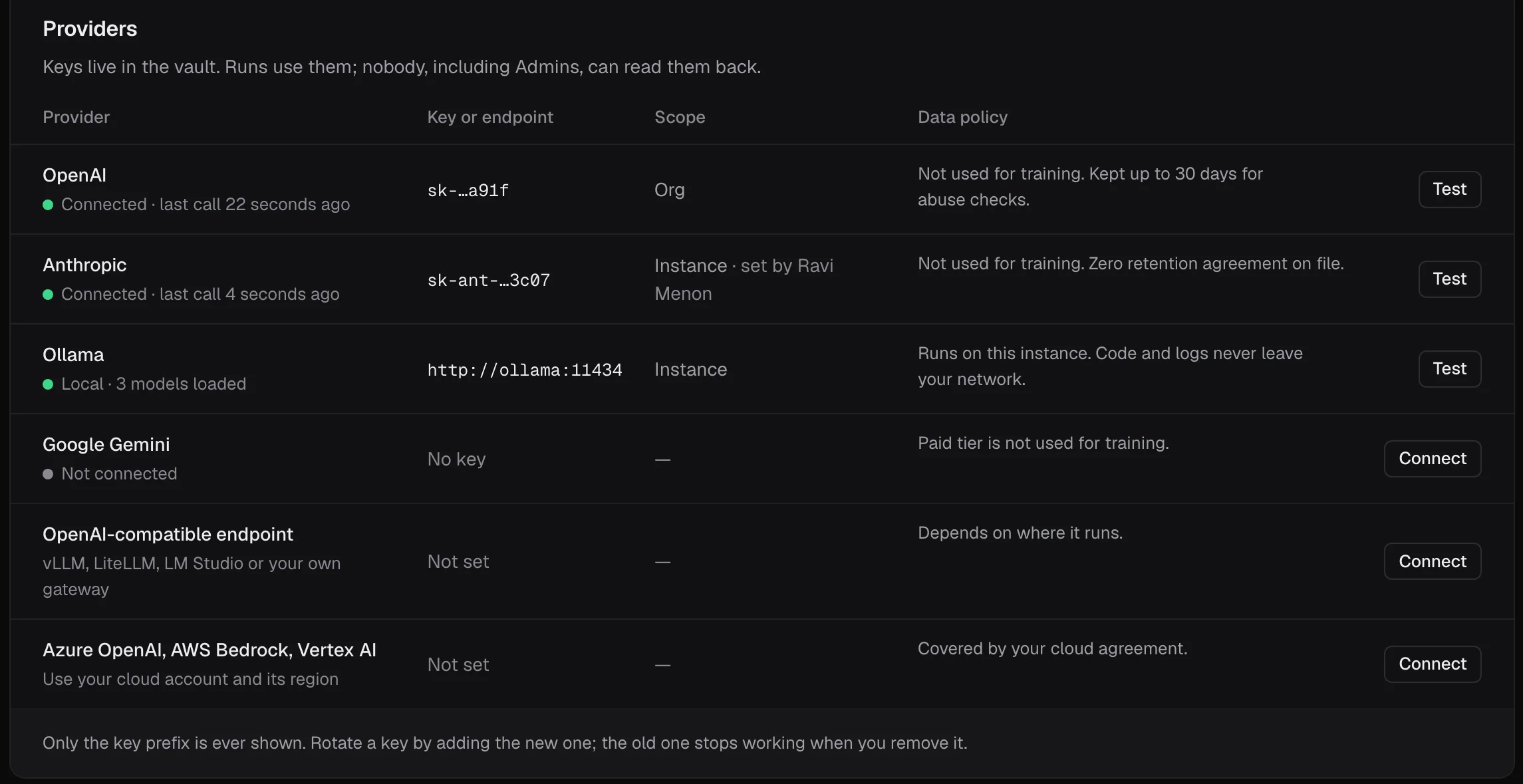
Each step asks for a tier, fast, balanced or strongest, never a model name. You map tiers to the providers you trust, with fallbacks and budgets.
We recommend Claude for the strongest tier. Small local models without tool calling still work: Mendloop asks them which evidence they need, fetches it, and has them answer in JSON.
Start in your app
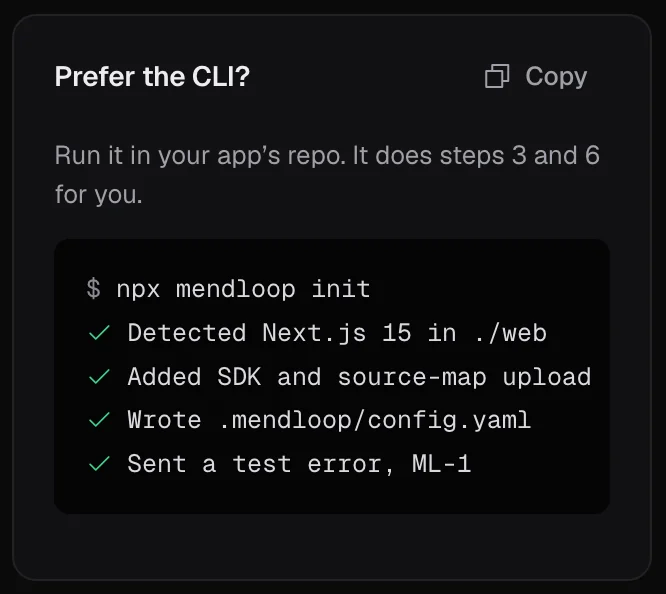
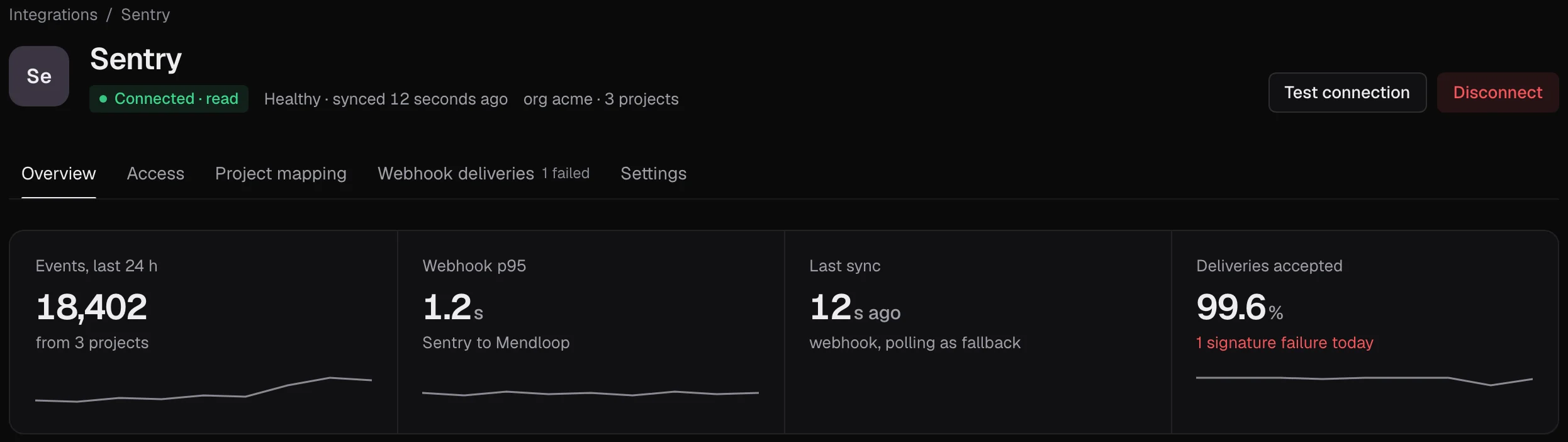
Run npx mendloop init in your app’s repository. It finds your framework, adds the SDK and source-map upload, writes the config and sends a test error. Or keep Sentry and change only the DSN.
Build it with us
Issues, ideas and pull requests are welcome. Integrations are plugins with a template, so a new tool is one package.

Mends you can see
Kintsugi leaves the repair in plain sight. So does an open codebase.
Read every prompt, every investigator and every rule that decides what Mendloop may write. If you disagree with one, change it and send it back.
Tea bowl, Korea, Joseon dynasty, 16th century, repaired with gold lacquer. Ethnological Museum, Berlin. Photograph by Daderot, CC0.